Like most people I know, I've never really thought much about punitive damages (at least, I assume that's the case - you never know what people like to ponder in their free time), but an article in the NY Times last week (Foreign Courts Wary of U.S. Punitive Damages) got me thinking: What is the point of awarding large sums of money - beyond the actual damages suffered - to plaintiffs in civil lawsuits?
While Americans are used to hearing about large punitive damage awards (despite the active movement to limit punitive damages in the United States, they are a fairly settled point in our legal system), they're relatively uncommon in other countries. English law severely restricts the circumstances in which they can be awarded, while Japanese law prohibits the enforcement of any punitive damages awarded by foreign courts.
In the case outline in the Times article, Judy Glebosky, an Alabama woman had sued an Italian manufacturer after the buckle on one of their motorcycle helmets failed in an accident, killing her son. The Alabama court awarded the woman $1 million in punitive damages, but the company refused to pay. Last year, the Italian Supreme Court sided with the company, blocking Glebosky's efforts to collect because they found the notion of punitive damages to be offensive to Italian ideas of justice.
Now, I've always been vaguely in favor of courts awarding punitive damages, especially when there's clear evidence of sleaziness, if not direct proof of wrongdoing, on the part of big corporations. Exxon Mobil, tobacco companies, I'm looking at you. Corporations may legally qualify as individuals, but it's damn hard to throw those 'individuals' in jail, even if you do manage to get a conviction, which is enough of a challenge in itself. How do you punish a corporation for breaking the law?
Sometimes it's enough to simply make them compensate the plaintiff(s) for the actual provable harm caused by corporate malfeasance. But if the point of the punishment is also to deter future crime, you have to decide whether having to shell out for compensatory damages really is enough to stop a company from committing the same irresponsible and/or illegal action in the future. Maybe they'll get caught again, but the cost of settling the cases that do come up is usually outweighed by the savings that made the irresponsible and/or illegal action seem like a good idea in the beginning - it's incredibly unlikely that they'll have to pay out in every case. In the end, money speaks, and because punitive damages involve larger sums, they speak louder than compensatory damages.
At this point, punitive damages - governed by state laws - are pretty standard practice in this country. It is an understatement to say that there has been a fairly vocal movement to limit punitive damages - opponents have been screaming for limits, or outright prohibition, at the tops of their lungs. But despite all that, the large awards that you hear about are rare within the system - the median award is closer to $40,000, and punitive damages are only actually awarded in around 2% of the civil cases that do end up in trial. While efforts to cap punitive damages have failed to pass constitutional muster, most punitive awards larger than 4 times the compensatory damages are questioned for the same reason. We all remember last year, when the Supreme Court overturned $80 million in punitive damages against Phillip Morris awarded to the widow of a smoker in Oregon. I know I was pissed when that happened.
Which is why I was kind of surprised when I didn't feel that bad for Glebosky. Not that I suddenly discovered that punitive damages were a bad thing, but I did wonder why she needed the money - as she said, it's not going to bring her son back. I know I felt more certain about rulings against the tobacco companies because that money was going to go to anti-smoking education.
I don't have any clear conclusion to these musings, but I guess I just wish there were a better way of punishing corporate malfeasance than just throwing money at the problem. Maybe having to pay large sums does provide the proverbial slap in the face for corporations who would otherwise cut corners (or outright lie to consumers) in order to raise profits, but is it really enough? And with punitive damages going directly to plaintiffs, you get the impression that they're being excessively rewarded for their victimhood, which really only helps corporations in their fight against responsibility. On the other hand, who else do you give them to?
Saturday, April 5, 2008
Money speaks, but does it speak well?


Tuesday, April 1, 2008
Silly games
 They always say the three taboo subjects are as follows: sex, politics, and religion. But no topic draws up the greatest amount of emotion from the fires within people quite like sports. Talk to any Duke fan and they'll go boo-hoo over the seemingly inexplicable amount of hated slung at their team (and then go boo-hoo over another early NCAA Tournament flameout). Wear a Giants hat in Los Angeles and you won't be invited for any more Scrabble Nights at your neighbor's. Show any sign of affinity for the Dallas Cowboys and I'll immediately remove you from my "Top Friends" on MySpace. In our democratic, open, and tolerant society that we enjoy, SP&R are so old-hat. But if another team from Boston wins a championship, then the terrorists have won.
With that in mind, what better place to incite political and social discussion than your weekly dose of Monday Night Football?
Sports serve as a microcosm of the world we live in, as the small segment of the population that we watch compete every day on television is put under a microscope. Every move the athletes make on a playing field or within an arena is scrutinized, and so is every aspect of their lives. The unfortunate death of Sean Taylor (age 24 at death) served as a reminder that "the leading cause of death for black men 15 to 24 is homicide." The probable bolt of college stars Michael Beasley and Derrick Rose to the NBA only adds to already low graduation rates among black students from college. UCLA star freshman Kevin Love has stated that remaining in school for another year is not a "financial issue" for him. I don't know what the financial situation is for Beasley or Rose, but with millions of dollars in their future as high draft picks I don't find it to be just a coincidence that Kevin Love is white and from an affluent suburb (Lake Oswego, Oregon) while Beasley and Rose are both African-American and came from predominantly black urban areas (Baltimore-Washington, D.C. and Chicago, respectively).
Lest we forget the revelry of George Bush throwing the first pitch of Game 3 of the 2001 World Series in Yankees Stadium in the wake of the terrorist attacks of September 11th. What could be more political than the leader of the free world bringing back a sense of "normalcy" by appearing in the home of the most popular team of "America's Pastime," who also happen to don an Uncle Sam hat in their logo?
With the Summer Olympics looming on the horizon for China, it's safe to say the Chinese Communist Party is nothing short of embarrassed over the turmoil erupting in the disputed province of Tibet and the protests and discussion that it has sparked worldwide. Having experienced their collective excitement firsthand in a trip to China last year (here's a picture of me in front of the newly constructed Beijing National Stadium), the people and government of China are treating the Games as more than just a global revelry of sports and nationalistic pride, but as their welcoming party into the world stage. Having long been the 1.3 billion-large Communist elephant in the room of global politics, the Chinese people are viewing the Summer Games as their globalization bar mitzvah.
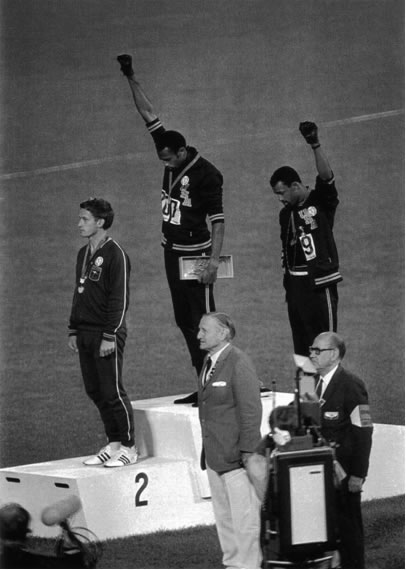
That's fine and all; as I said before we've always attached an inflated sense of value to what is basically men and women playing a game and there is nothing wrong with that. So then why are people backing off from the notion of a full boycott of the Olympic Games saying that the Olympics are not a place for politics? The Olympics are a perfect place for politics. If that's not the case then Jesse Owens showing up Hitler in his own backyard, the Black Power salute in the 1968 games, and the Miracle On Ice are all just another moment in the dominance of the United States in international competition and nothing more. What other time do you have every nation of the world represented in a forum where the spotlight is shining down upon them and millions of people are watching? Last time I checked, the General Assembly of the United Nations doesn't draw a high Nielsen rating.
So this August when the Games start, don't forget the charter of the Olympics aims to "create a way of life based on the joy found in effort, the educational value of good example and respect for universal fundamental ethical principles." I'm not calling for or supporting any sort of boycott of the Olympics, but I don't want people to let the Chinese government's blatant abuse of human rights not only in Tibet but throughout their country swept underneath the rug in the midst of the seemingly benign Games.
Sports are just fun and games, but they can be so much more than that. And that's why I love them.
photograph by shalvas